PTSTORM
Extreme Precipitation Response to Temperature Variations
What the project is about
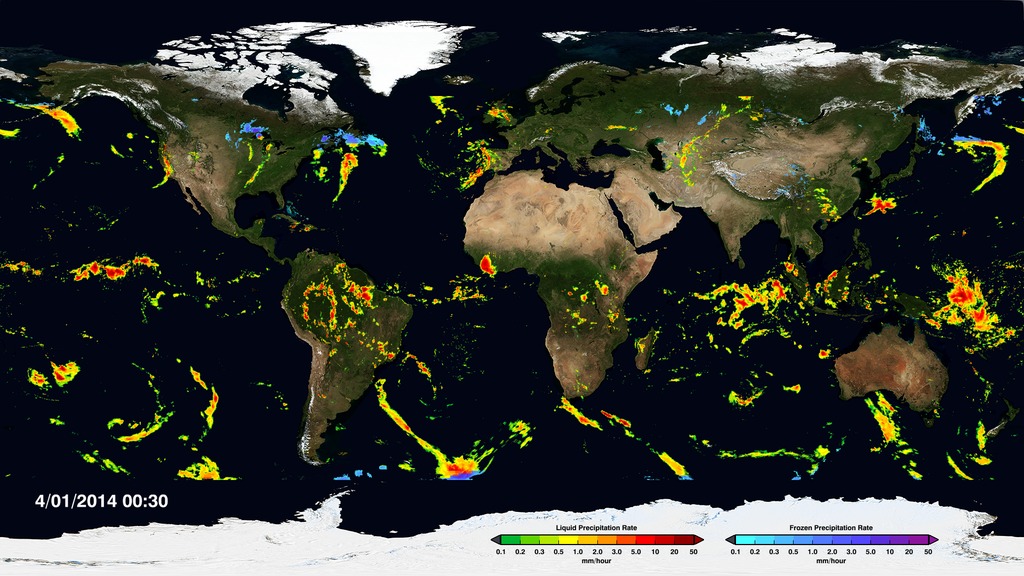
The overarching objective of PTSTORM is to improve our understanding of the relationship between extreme precipitation and atmospheric temperature. Current approaches rely on scaling relations that mimic the exponential increase in water vapor availability with temperature, as predicted by the Clausius–Clapeyron equation — but these fail to account for the fact that extreme events are generated by diverse physical processes, which may themselves be shaped by large-scale drivers.
PTSTORM will provide a more realistic representation of the precipitation–temperature relationship by explicitly considering the dependence on the generating precipitation process and on large-scale atmospheric circulation (LAC) patterns.
- Classify storm types and associated precipitation characteristics globally.
- Quantify temperature–precipitation scaling across storm types and regions.
- Assess modulation of extremes by large-scale circulation regimes.
Methodology
The project combines satellite precipitation products (e.g. GPM IMERG), reanalysis datasets, and statistical models. Results will inform process-based interpretations and improve predictive models for extreme precipitation under changing climate conditions.
Funding
Funded by the European Union. Views and opinions expressed are however those of the author only and do not necessarily reflect those of the European Union or the granting authority. Neither the European Union nor the granting authority can be held responsible for them.
Timeline
Planned phasing for the 2025–2027 fellowship.
Year 1 · 2025–2026
Storm classification & scaling analysis
Build the global storm-type classification, assemble satellite/reanalysis datasets, and quantify temperature–precipitation scaling by storm type and region.
Year 2 · 2026–2027
Circulation analysis & dissemination
Assess modulation of extremes by large-scale circulation regimes; consolidate findings into publications, share data/code, and present results at conferences.
Outputs
Related publications
Findings that feed into or build on this project will be listed here as they're published. See the full publications list in the meantime.
Visuals
Gallery
Photos, figures, and conference snapshots from the project will appear here as they become available.
Writing
Blog
- No posts yet — updates from the project will appear here.
Openness
Data & code availability
Datasets and analysis code produced by this project will be made openly available as outputs are finalized. Links to repositories (e.g. Zenodo, GitHub) will be added here.
Log
News & updates
- No updates yet — check back as the project progresses.